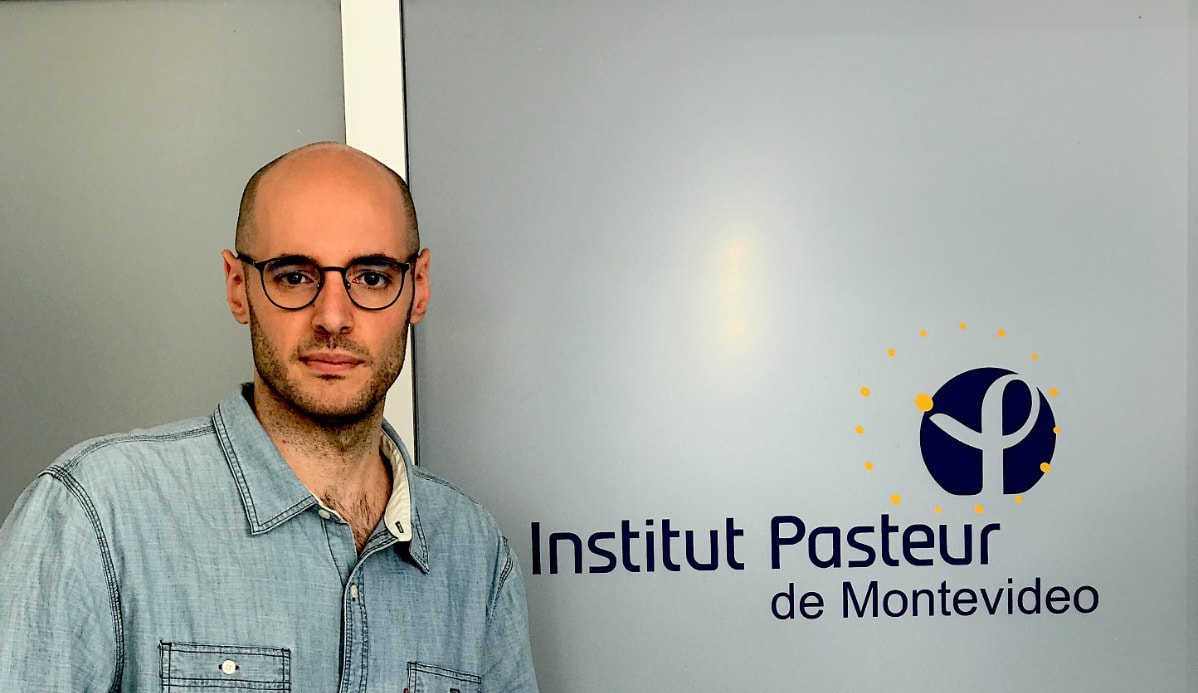
The International Brain Research Organization (IBRO), which has brought together neuroscientists from around the world since 1961, distinguished this week Emiliano Trías, researcher at the Neurodegeneration Laboratory of the Institut Pasteur de Montevideo, with the IBRO Young Investigator Award 2021.
Each year, the award grants 5,000 euros to a researcher to fund the work of their laboratory and help them take their first steps in their postdoctoral career. The Neurodegeneration Laboratory at the Institut Pasteur has been studying neurodegenerative diseases for many years.
Emiliano Trías and his research team investigate diseases such as Alzheimer’s, amyotrophic lateral sclerosis (ALS) and premature brain aging. They study how our brain cells age, why aging sometimes occurs prematurely and why cells die in neurodegenerative diseases.
Trías explained that the research team he leads is working on drugs that are capable of halting the progression of these diseases. “In particular, for the last ten years we have been working with a drug called Masitinib, which inhibits or blocks the toxic effect of some types of cells of the immune system on neurons and on muscles and nerves,” said Trías, adding that it is showing “very good, very promising” results.
Based on preclinical studies and studies of its mechanisms of action, this drug began to be tested in clinical trials with very promising results, to such an extent that a new phase 3 clinical trial with hundreds of patients will begin in the next few months. If these positive results are confirmed, the drug could reach the clinic and help patients.
Trías and his group also recently published an article in the journal Acta Neuropathologica Communications that took several years of work. Carried out by IP Montevideo researcher Mariángeles Kovacs as part of her PhD, the study describes in depth, for the first time, the presence of a type of immune cell (mast cells) in the nervous system (brain and spinal cord) of ALS patients.
Trías holds a degree in Biological Sciences from the Faculty of Sciences of Udelar, and a master’s degree and a PhD in neurosciences from the Program for the Development of Basic Sciences (PEDECIBA). Since 2014 he has been a member of the Neurodegeneration Laboratory at the Institut Pasteur de Montevideo, where he completed his postdoctoral studies in cellular neuroscience. He is co-founder and Chief Scientific Officer (CSO) of Xeptiva Therapeutics.
Xeptiva Therapeutics LLC is a clinical-stage biotech company dedicated to the development of immunotherapies to treat conditions associated with chronic neuroinflammation in companion animals. The company was created with the mission to improve companion animals’ healthspan (quality of life) and lifespan (years of life) by developing simple, affordable, disruptive and highly effective immunotherapies.
The Institut Pasteur de Montevideo (IP Montevideo) is one of the most recent affiliates of the Institut Pasteur International Network (RIIP in French), composed of 33 independent centers located in five continents and united by the same values. Dedicated to scientific research in biomedicine, IP Montevideo is composed of high-tech scientific platforms in areas such as genomics, proteomics, bioinformatics, molecular and cellular biology. Its laboratories are open to young scientists’ research projects, it has become an international education center with courses on the latest biological knowledge and state-of-the-art technologies, and it promotes start-ups for the development of biotechnological applications.
IBRO is the global association of neuroscience societies, established in 1961, that aims to promote and support neuroscience around the world through training, education, research, outreach and engagement activities, and the publication of its two journals, Neuroscience and IBRO Neuroscience Reports.